Source: Reuters
Taking a page out of its playbook, the Department of Energy has replaced a roof at its headquarters in Washington, D.C., with a cool roof made from light-colored material that is expected to save taxpayers $2,000 a year energy costs.
The new cool roof covers 25,000 square feet atop the DOE's Headquarters West Building. In spring, the department plans to replace the 66,000-square-foot roof of the DOE Headquarters South Building with a cool roof. Together, the new roofing systems, which include increased insulation, are expected to save taxpayers $8,000 in energy costs.
Roofs made with white or light-colored materials or similarly hued special coatings reflect heat and absorb less solar energy than traditional roofs so that buildings require less energy for cooling. Cool roofs also reduce the heat island effect caused by a concentration of black or dark-colored surfaces such as traditional roofs, pavement and parking lots.
According to researchers at Lawrence Berkeley National Laboratory, using roofs and pavement made with light-colored materials in urban areas around the globe can potentially cancel the heating effect of as many as two years of worldwide carbon dioxide emissions.
In July, Energy Secretary Steven Chu announced the DOE's Cool Roof initiative and directed his department to install cool roofs when constructing new ones, or replacing old ones, as long as it is cost effective to do so. Chu also urged other department heads and agency leaders to do the same, and he released the DOE's Guidelines for Selecting Cool Roofs.
The cool roofs concept got another boost this fall when New York City highlighted its CoolRoofs program as part of Climate Week NYºC 2010.
"The reason why we wanted the DOE to take the lead in cools roofs is to demonstrate that this really saves money," said Chu on Tuesday in announcing the completion of the cool roof on the DOE Headquarters West Building. Installing light-colored instead of traditional material did not add to the costs for the roof replacement project, according to the DOE.

Showing posts with label cool roofing. Show all posts
Showing posts with label cool roofing. Show all posts
Thursday, December 16, 2010

Wednesday, October 27, 2010
Cool Roofs - A Piece Of The Green Puzzle
Source: RoofingContractor
As green building strategies evolve to keep up with increasingly stringent building energy codes and standards, so do cool roofs. A roof, as any other building component, can be selected to best serve a particular purpose, such as weather resistance or thermal regulation. Cool roofs are optimally designed to minimize the transfer of heat from the sun to the interior of a building.
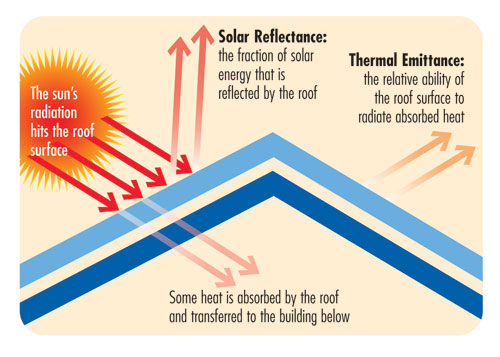
A cool roof is defined by the radiative properties of the roof’s outer layer, or more specifically, by its solar reflectance and thermal emittance properties. Solar reflectance is a measure of the portion of initial solar radiation that is immediately reflected off the roof surface back in the atmosphere without heating the roof itself. Thermal emittance is a measure of the solar energy that the roof re-emits, or re-releases into the atmosphere as infrared light, after being initially absorbed. The remainder of the solar energy, that which is neither reflected nor re-emitted, is transferred to the building as heat or is convected by ambient breezes into the surrounding atmosphere, heating the surrounding air. The amount of solar energy transferred to a building can therefore be influenced by the roof design and construction (See below).

Thanks to advances in materials technology, white roofs are no longer the only type of cool roof available. Cool color pigments have been developed to efficiently reflect solar energy (light) in the Near Infrared (NIR) spectrum, whereas standard colors tend to absorb NIR energy. The NIR spectrum is invisible to the human eye, so two seemingly identical colors in the visible spectrum can perform differently in the NIR spectrum. With vast color and material choices, selecting an aesthetically pleasing roof design while maintaining cool roof performance is now possible.
In addition to reduced building energy consumption from diminished air conditioning requirements, cool roofs have numerous indirect benefits, including cutting greenhouse gas emissions, alleviating the urban heat island effect, reducing smog, as well as various public health benefits.
Cool roofs reduce greenhouse gas emissions by conserving electricity and reducing power plant production demand incurred from air conditioning use. Creating electricity not only wastes a great deal of energy in the conversion process, but also produces CO2, particulate matter and other air pollutants.
Cities can be 2 degrees to 8 degrees warmer than surrounding environments due to the large areas of dark surfaces, consisting mainly of roads, parking lots and dark-colored roofs. The extra heat absorbed through dark surfaces during the day is convected away by ambient breezes, raising air temperature averages; this phenomenon is referred to as the urban heat island effect. Cool roofs help mitigate the intensity of the urban heat island effect by reducing heat absorption and transfer to the surrounding air.
Lower ambient air temperatures resulting from cool roof applications also reduce the production of smog, a process accelerated by warmer temperatures. Reduced greenhouse gas emissions and smog production benefit public health by reducing the prevalence of asthma and other respiratory health conditions aggravated by air pollution.
As building technologies improve, building codes and programs have evolved to enforce strategic green building design and construction practices. The following section provides an overview of some cool roofing codes, green building programs, rebate programs and tax credits. For more information, please visit www.coolroofs.org.
Two primary organizations, the International Code Council (ICC) and the American Society of Heating and Air- Conditioning Engineers (ASHRAE), have developed National Model Energy Codes. These codes are not mandatory or enforceable until a jurisdiction adopts the documents as part of regulation or law. In the United States, many states and jurisdictions have adopted these codes, while others like California have developed their own.
Rebate Programs: As the green building movement sweeps the country, more utilities across the United States are providing incentives for cool roofs. States with current utility rebate programs include Arizona, California, North Carolina, South Carolina, Georgia, Colorado, Florida, Idaho, New Jersey, New York and Texas.
Cool roof purchases before December 31, 2010 qualify for a $1,500 dollar tax credit. For more information please visit our website.
As green building strategies evolve to keep up with increasingly stringent building energy codes and standards, so do cool roofs. A roof, as any other building component, can be selected to best serve a particular purpose, such as weather resistance or thermal regulation. Cool roofs are optimally designed to minimize the transfer of heat from the sun to the interior of a building.
A cool roof is defined by the radiative properties of the roof’s outer layer, or more specifically, by its solar reflectance and thermal emittance properties. Solar reflectance is a measure of the portion of initial solar radiation that is immediately reflected off the roof surface back in the atmosphere without heating the roof itself. Thermal emittance is a measure of the solar energy that the roof re-emits, or re-releases into the atmosphere as infrared light, after being initially absorbed. The remainder of the solar energy, that which is neither reflected nor re-emitted, is transferred to the building as heat or is convected by ambient breezes into the surrounding atmosphere, heating the surrounding air. The amount of solar energy transferred to a building can therefore be influenced by the roof design and construction (See below).
Thanks to advances in materials technology, white roofs are no longer the only type of cool roof available. Cool color pigments have been developed to efficiently reflect solar energy (light) in the Near Infrared (NIR) spectrum, whereas standard colors tend to absorb NIR energy. The NIR spectrum is invisible to the human eye, so two seemingly identical colors in the visible spectrum can perform differently in the NIR spectrum. With vast color and material choices, selecting an aesthetically pleasing roof design while maintaining cool roof performance is now possible.
In addition to reduced building energy consumption from diminished air conditioning requirements, cool roofs have numerous indirect benefits, including cutting greenhouse gas emissions, alleviating the urban heat island effect, reducing smog, as well as various public health benefits.
Cool roofs reduce greenhouse gas emissions by conserving electricity and reducing power plant production demand incurred from air conditioning use. Creating electricity not only wastes a great deal of energy in the conversion process, but also produces CO2, particulate matter and other air pollutants.
Cities can be 2 degrees to 8 degrees warmer than surrounding environments due to the large areas of dark surfaces, consisting mainly of roads, parking lots and dark-colored roofs. The extra heat absorbed through dark surfaces during the day is convected away by ambient breezes, raising air temperature averages; this phenomenon is referred to as the urban heat island effect. Cool roofs help mitigate the intensity of the urban heat island effect by reducing heat absorption and transfer to the surrounding air.
Lower ambient air temperatures resulting from cool roof applications also reduce the production of smog, a process accelerated by warmer temperatures. Reduced greenhouse gas emissions and smog production benefit public health by reducing the prevalence of asthma and other respiratory health conditions aggravated by air pollution.
As building technologies improve, building codes and programs have evolved to enforce strategic green building design and construction practices. The following section provides an overview of some cool roofing codes, green building programs, rebate programs and tax credits. For more information, please visit www.coolroofs.org.
Two primary organizations, the International Code Council (ICC) and the American Society of Heating and Air- Conditioning Engineers (ASHRAE), have developed National Model Energy Codes. These codes are not mandatory or enforceable until a jurisdiction adopts the documents as part of regulation or law. In the United States, many states and jurisdictions have adopted these codes, while others like California have developed their own.
Rebate Programs: As the green building movement sweeps the country, more utilities across the United States are providing incentives for cool roofs. States with current utility rebate programs include Arizona, California, North Carolina, South Carolina, Georgia, Colorado, Florida, Idaho, New Jersey, New York and Texas.
Cool roof purchases before December 31, 2010 qualify for a $1,500 dollar tax credit. For more information please visit our website.
Subscribe to:
Posts (Atom)